Cal-FHR (Fluoride Salt-Cooled High Temperature Reactor Core Design)
The Cal-FHR is a novel 4th-generation reactor core design utilizing advanced reactor fuels, coolants, and structural materials. FHRs use a molten fluoride salt to cool the reactor core, allowing for higher coolant temperatures which translates to higher thermal efficiency for the power plant. Additionally, fluoride salts have many intrinsic safety features, such as the ability to operate the reactor at atmospheric pressure.
Our reactor design is unique to most FHRs due to our cylindrical core assembly. Most FHR designs use a pebble bed reactor core. However, most commercial reactors use a cylindrical core, thus our reactor acts as a bridge between commercial reactors and next-generation reactors. This project was advised by members of our industry sponsor, Westinghouse. Our design also had to meet certain specifications given to us by our sponsor such as low uranium enrichment, high power density, low cost, and a fuel cycle equal to or greater than 12 months.
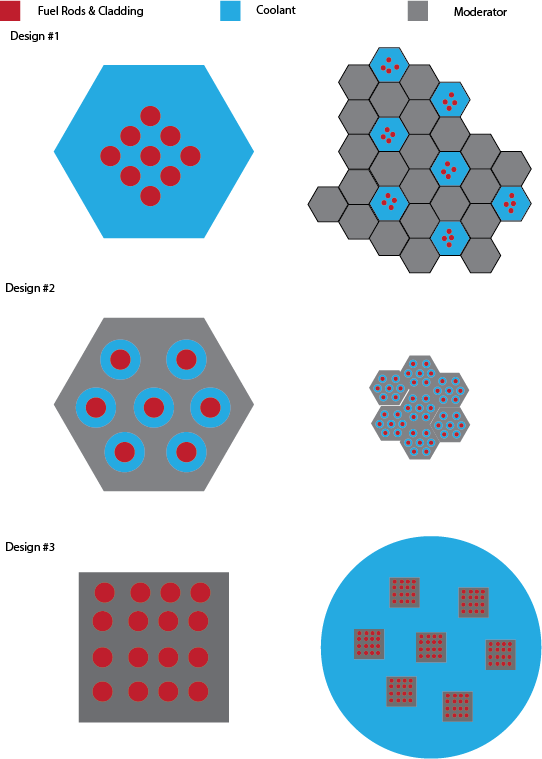
Our design process consisted of three overlapping phases. The first phase primarily consisted of the literature research, materials selection, and core geometry arrangement. The second phase consisted mainly of simulations, using Serpent for the neutronics and COMSOL for the thermo-hydraulics. Phase three was the evaluation of the reactor design in terms of cost, safety, lifecycle, etc.
The literature research greatly narrowed down our choices for our material selection. About one or two selections were chosen for each of the fuel, cladding, coolant, and moderator materials. Materials that weren't currently in commercial production were still considered, assuming they might be available in the future. We also considered several pin assembly geometries, however we quickly narrowed our design to one geometry after some initial mathematical analysis and advice from our sponsor.
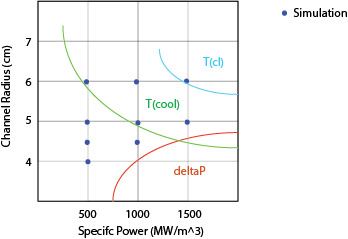
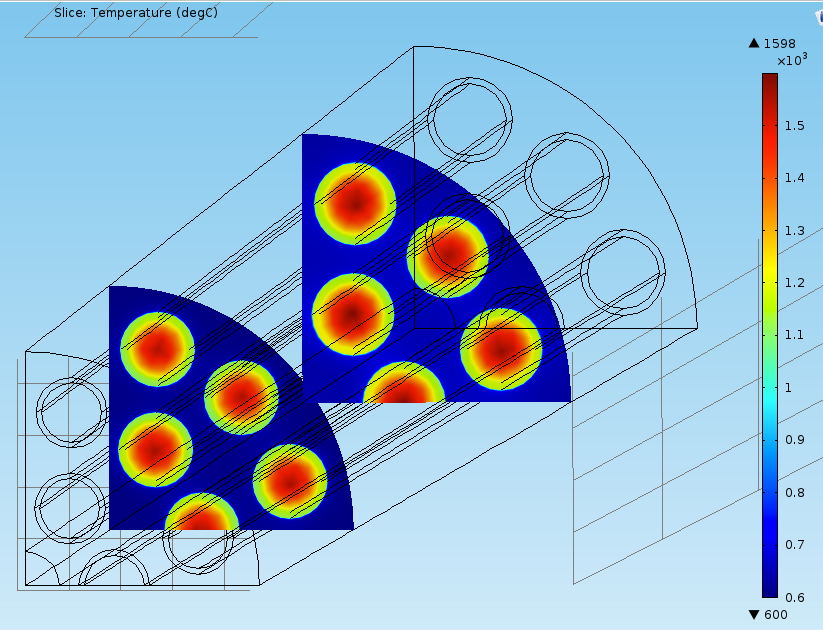
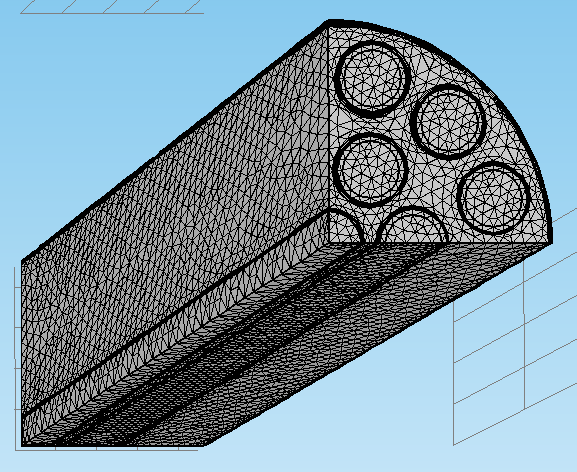
For the design to be thermo-hydraulically viable, it had to stay below a maximum pressure drop, coolant temperature, and fuel temperature. These values were plotted against a range of fuel power densities and assembly geometries. Through multiple simulations, a feasibility region was mapped where the reactor could safely operate, as well as an optimal geometry for the largest power density.
The neutronics simulations were performed to calculate several important parameters including geometries for optimal neutron moderation, minimum fuel enrichment levels, and negative reactivity. We also performed a burn-up analysis to determine fuel cycle lengths for several fuel, enrichment, and coolant combinations.
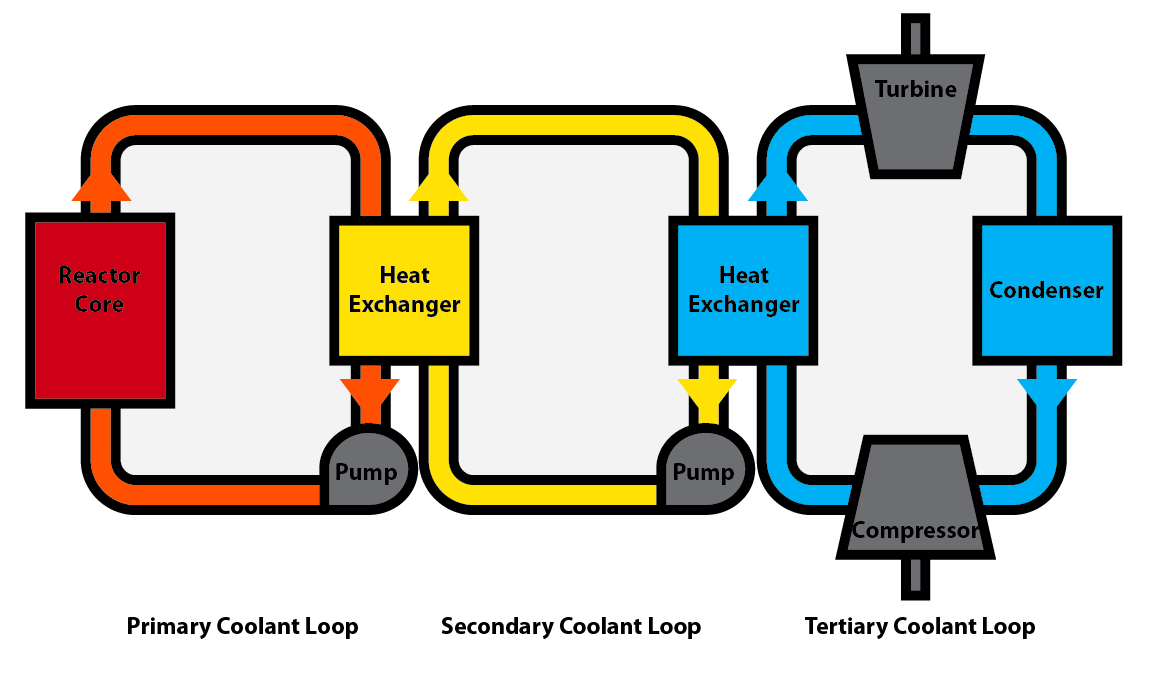
The final analysis on external systems found challenges to FHR designs including concerns over toxicity, chemical corrosion, and high temperature. Our research found that using an intermediate coolant loop between the fluoride salt and water alleviated several of these obstacles. There are also several cost advantages of FHRs over light water reactors due to their lack of pressure vessel and their thermal efficiency. These costs may be offset by the price of new materials and the enrichment of fuel and coolant, although these costs may go down over time. The design also benefit from some safety features due to the lack of pressure vessel, however gains some safety issues due to toxicity and corrosion in the coolant loops.
Our final results indicate that our design is still a decade away from full-scale development. There are many advanced materials that require further research and sufficient production levels. However, we do find the potential to operate a 1 GW reactor with UN fuel and FLiBe coolant that meets the design requirements and is competitive in price and safety with current reactors.
Team Members
- Ahlad Reddy
- Mark Swanson
- Adriana Ureche
- Alan Yamanaka
- Professor Massimilano Fratoni (Advisor)